
In the rush to deploy enterprise AI, teams often obsess over model accuracy, processing speed, and architectural scale. However, they frequently overlook what decides whether the technology actually takes hold: the human element.
A machine learning model is only as valuable as the business’s willingness to use it. If your operations team doesn’t trust the outputs of your Intelligent Document Processing (IDP) pipeline, the technology underneath doesn’t matter. People fall back to manual, line-by-line review, and the ROI of the entire initiative quietly disappears.
At Hyperscience, we’ve learned that successful automation is as much about managing change as it is about parsing data. Trust isn’t a byproduct of accuracy, it has to be designed in. Here’s how.
Trust Is the Currency of Automation
Imagine deploying a state-of-the-art document processing pipeline that boasts 95% accuracy. On paper, that’s a win. On the ground, it plays out differently: if users don’t know which 5% is wrong, they treat 100% of the documents with suspicion.
The problem isn’t the error rate. It’s the uncertainty about where the errors live. Uncertainty fosters anxiety, and anxious operators don’t delegate.
When people lack confidence in a machine’s output, a predictable anti-pattern emerges: shadow processing. Employees start double-checking the AI’s work, comparing every digitized field against the original PDF just to be safe. At that point, you’re no longer automating the process. You’ve added an expensive, redundant software layer on top of your manual workflow. The labour hasn’t disappeared; it has been redistributed, from processing documents to policing models. Work expands to fill the trust that’s missing.
To break this cycle, you have to build systems that are intentionally designed to earn trust.
Engineering Trust Through Interpretability and Feedback
Trust can’t be dictated from the top down. It has to be engineered into the platform from the ground up. And the ingredients are the same ones that build trust between people: predictability, so the system behaves consistently; transparency, so it shows its reasoning; and reciprocity, so it visibly responds when you correct it.
In practice, this comes down to two foundational pillars. Users need to see why the model is confident, and they need a frictionless way to set it straight when it’s wrong.
1. Interpretability: The UI Matters
When it comes to AI adoption, the interface is as important as the algorithm. An answer without evidence is just an assertion, and no operator stakes their work on an assertion. The platform has to show its work, surfacing clear, contextual evidence for every extraction.
Contextual confidence scores
Users should never have to guess how sure the machine is. Field-level confidence scores let operators triage their work instantly, focusing only on the data points the machine itself flagged as uncertain.
A score however, is only as trustworthy as what stands behind it. A model’s confidence is just its opinion of itself, and like any opinion, it can be strongly held and still wrong. That’s why the Hyperscience platform doesn’t take the model at its word: it continuously verifies the machine’s output through human QA and calibrates confidence accordingly. Automation proceeds only when that grounded confidence clears a threshold tied to the accuracy the business requires. It’s how trust works between people, too: we don’t extend it to whoever sounds most certain, but to those who’ve built a track record.
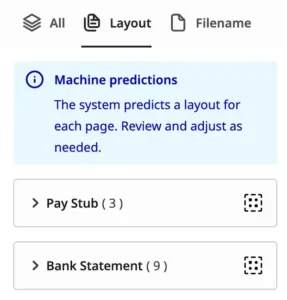
We’ve recently taken this a step further: in manual classification tasks, the operator sees the machine’s best guess alongside the document. Instead of starting from a blank slate, they start from the model’s reasoning and simply confirm or correct it. The machine shows its hand first.
Side-by-side verification
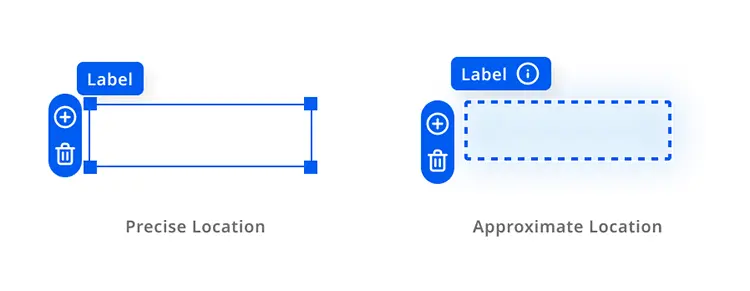
The UI should place the original document and the extracted data next to each other, so a human can verify a name, date, or amount in a fraction of a second. In our platform, this takes two forms, matched to what the model actually knows. When the model can pinpoint exactly where a value came from, it draws a precise bounding box around the source text. When it can only narrow the answer down to a region, it shows an approximate location instead, and is explicit about that. This honesty matters: a system that admits the limits of its own precision is far more credible than one that fakes certainty.
2. Continuous Feedback Loops: Every Keystroke Counts
Mistakes will happen. Documents are messy, formats drift, and edge cases are a fact of enterprise life. Trust doesn’t depend on the machine being flawless. It depends on what happens after the mistake. When a person corrects a machine error, that keystroke shouldn’t vanish into a void; it should visibly make the system better.
Active learning
Modern IDP platforms must treat every human intervention as valuable training data. In the Hyperscience platform, this is woven into the operating rhythm through QA tasks: a steady sample of machine output is routed to people for review, and every judgment they make feeds back into the system. The result is automation that is continuously audited and continuously improving, and operators who can watch their corrections compound over time. Nothing builds trust faster than seeing the machine learn from you.
Frictionless correction
If fixing an error takes longer than typing the value from scratch, users will reject the tool, and rightly so. This is where our suggestion engine comes in. Rather than asking the operator to re-key a field, the platform generates ranked suggestions for the correct value, turning most corrections into a single click. The cost of supervising the machine drops to nearly nothing, and review stops feeling like rework.
From Black Box to Reliable Colleague
The goal of enterprise automation was never to replace human intelligence. It is to change what human intelligence is spent on.
In a well-designed system, machines do the heavy lifting: reading, extracting, classifying, and routing documents at a scale no team could match. The system stays transparent at every step, its reasoning open to inspection and its decisions available for human supervision at all times. And people move into the role they should have had all along: custodians of the process, moderators of the edge cases, partners to the machine rather than its proofreaders.
Prioritize interpretability and continuous feedback, and the numbers follow: manual processing time and error rates drop. But the deeper shift is one of perspective. Teams stop viewing the AI as an opaque, error-prone black box, and start treating it as exactly what it was designed to be: a reliable, high-speed partner.